Garbage Disposal Repair and Installation in Gainesville, FL
Garbage disposal repair covers the unit under your kitchen sink: jams, leaks, dead motors and the drain and dishwasher connections around it. Installation means swapping in a new disposal or adding one where there wasn't one before.
A jammed disposal can wait for a daytime visit. Water leaking into the cabinet is worth a call now, and the line is answered 24/7.
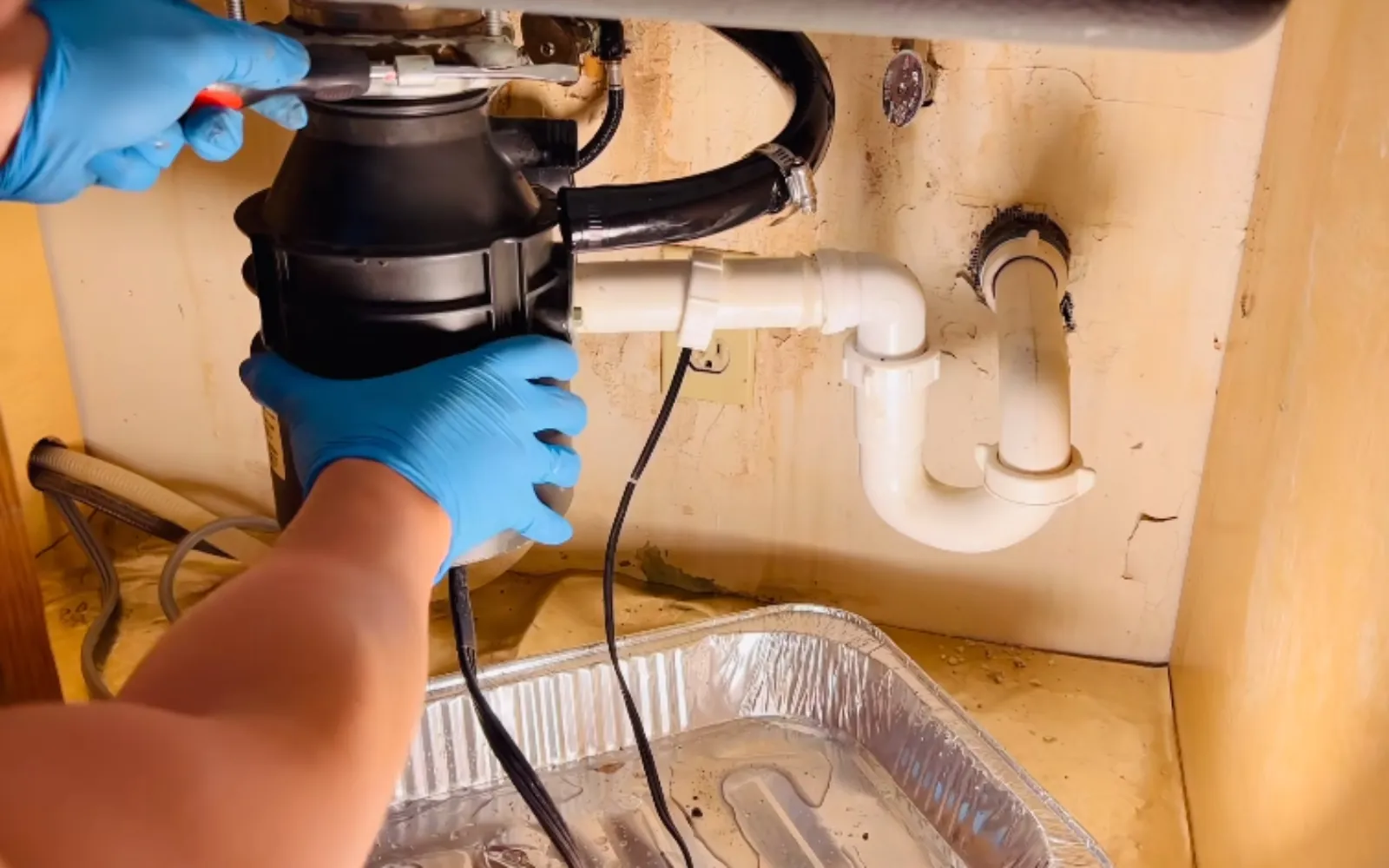
Humming, dead or leaking? Start here
Always switch the disposal off at the wall switch, and unplug it or flip its breaker, before trying any of these. Never put a hand inside the unit.
- It hums but doesn't spin. Something is jammed. Most units have a hex socket on the bottom center, and turning it back and forth with the matching wrench frees the plates.
- It's completely dead. Press the red reset button on the bottom. If it trips again right away, the motor is struggling or failing.
- It spins but drains slowly. The clog is usually in the drain line past the disposal, not the disposal itself.
- Water drips from the bottom. The internal seal has failed, and that means a new disposal.
If the reset and the hex wrench don't do it, stop there and call. Forcing a jammed unit burns out the motor.
Where the leak is tells you what failed
| Leak location | Likely cause | Fix |
|---|---|---|
| Top, where it meets the sink. | Loose mount or failed plumber's putty at the sink flange. | Reseal the flange. |
| Side, at the dishwasher hose. | Loose clamp or cracked hose. | Tighten or replace the hose. |
| Side, at the drain outlet. | Worn gasket or loose bolts on the discharge tube. | Replace the gasket. |
| Bottom of the unit. | Internal seal failure or a cracked housing. | Replace the disposal. |
What not to put down a disposal
Grease tops the list. It goes down liquid, then hardens further along the line where the disposal can't reach it. Pour cooking grease into a can, let it set and throw it out. In GRU homes, grease also ends up in the public sewer, which is why the utility runs a grease management program for businesses.
Stringy and starchy food causes most jams: celery, corn husks, onion skins, potato peels, and large amounts of rice or pasta that swell into paste. Fruit pits and bones can jam the plates. Small amounts of soft scraps with plenty of cold running water are what a disposal is built for.
If the kitchen line keeps backing up even when the disposal is used carefully, the pipe itself may have years of buildup. Drain cleaning clears it, and heavy grease may need hydro jetting.
Disposals on septic systems
Homes on septic tanks, common across rural Alachua County, can use a disposal, but it adds solids to the tank. That means the tank fills faster and needs pumping more often.
If your home is on septic, use the disposal lightly, keep grease out entirely, and plan on a shorter pumping interval. Our professional septic service can help set a schedule that fits how you use it.
What a disposal installation includes
- Remove the old unit. Disconnect power, drain and dishwasher lines, and take the old disposal off its mount.
- New mount and flange. A fresh seal at the sink so the top doesn't leak.
- Dishwasher connection. On a new disposal, the dishwasher inlet has a knockout plug that must be removed. Skipping it is a common reason a dishwasher suddenly won't drain.
- Drain alignment. The discharge tube and trap are lined up and sealed.
- Test. Run it with water, run the dishwasher drain, and check every joint for drips.
Repair or replace?
Jams, flange leaks and loose connections are repairs. A leak from the bottom, a cracked housing, or a motor that keeps tripping the reset button means the unit has reached its end. Disposals aren't built to be rebuilt internally, so replacement is the normal fix.
Size the new one to how you cook. A small household can do fine with a 1/3 or 1/2 horsepower unit. Busy kitchens do better with 3/4 horsepower or more, which grinds faster and jams less.
What affects the price
- Repair or replace. Clearing a jam or resealing a flange costs far less than a new unit.
- Horsepower and model. Larger, quieter units cost more.
- Electrical. Adding a disposal where there wasn't one may need an outlet or switch.
- Plumbing changes. A new unit that sits lower or higher may need the drain trap reworked.
Want your real number? Call (954) 697-4920. Replacement estimates are free.
Kitchen plumbing across the area
We handle disposal calls in Gainesville and in Alachua and the nearby towns. If the faucet above the disposal is dripping too, faucet and sink repair can be done on the same visit.
GRU oil and grease management program. Kitchen drain connections follow the Florida Building Code, Plumbing, based on the International Plumbing Code (IPC).
Garbage disposal questions
If water is actively leaking into the cabinet, close the sink shutoffs, stop using the sink and call. The line is answered 24/7. A slow drip can usually wait until morning with a bowl under it.
The knockout plug in the disposal's dishwasher inlet was probably never removed. It's a quick fix.
Often around 8 to 15 years, depending on the model and how it's used. Hard use and frequent jams shorten that.
Yes, with moderation. It adds solids to the tank, so the tank needs pumping more often.
Disposals don't have blades that sharpen. Ice can help knock loose buildup on the grinding plates, but it doesn't sharpen anything.
Yes, as long as there's room under the sink and power can be supplied. We'll check both before quoting.
It depends on the lease and the cause. A worn-out unit is usually the owner's cost, while a jam from bones or utensils may be billed to the tenant. We note what we found so the landlord can decide.