Leak Detection in Gainesville, FL
Leak detection is the process of finding where water escapes a plumbing system without tearing the house apart to look. In Gainesville, most of these calls start the same way: a GRU bill that jumped for no reason, a meter that keeps turning with every tap closed, or a damp spot nobody can explain.
We trace the leak with listening equipment, thermal imaging and pressure tests, then mark the spot before anything gets cut. The phone is answered 24/7 if water is showing up right now.
Meter spinning with every tap turned off?
That single symptom brings in more leak detection calls than any other. You can confirm it yourself in about ten minutes before you call anyone.
- Turn off every fixture and appliance. That includes the ice maker, the irrigation controller and any water softener that might be mid-cycle.
- Find the GRU meter box. It is usually near the street or sidewalk in a plastic or concrete box with a lid.
- Watch the low-flow indicator. Most meters have a small dial or triangle that spins with even a trickle. If it moves, water is leaving somewhere.
- Close the house shutoff and look again. If the dial stops, the leak is inside the house. If it keeps moving, the leak is in the buried line between the meter and the house.
Write down what you saw. That one test cuts the search area roughly in half before a plumber arrives.
Why a hidden leak costs Gainesville homeowners twice
GRU does not meter wastewater separately. Sewer charges are calculated from the water that passes through your meter each month. So a leak that pours clean water into the ground still shows up on the wastewater side of the bill.
A running toilet or a pinhole under the slab can run for weeks before the bill arrives. By then you have paid for the water twice. Finding it fast matters more here than in towns that bill sewer at a flat rate.
There is some relief available. GRU offers courtesy leak adjustments when a leak is verified and the repair is documented, and the credit is applied only after usage drops back to normal. Keep the detection findings and the repair invoice together. Those two papers are what the adjustment request needs.
How we find the leak without guessing
No single tool finds every leak. The method depends on what the pipe is made of, how deep it sits and whether the water is hot or cold.
| Method | How it works | Best for |
|---|---|---|
| Pressure isolation. | Sections of the system are shut off and held under pressure to see which one drops. | Narrowing a leak to the hot side, cold side or yard line. |
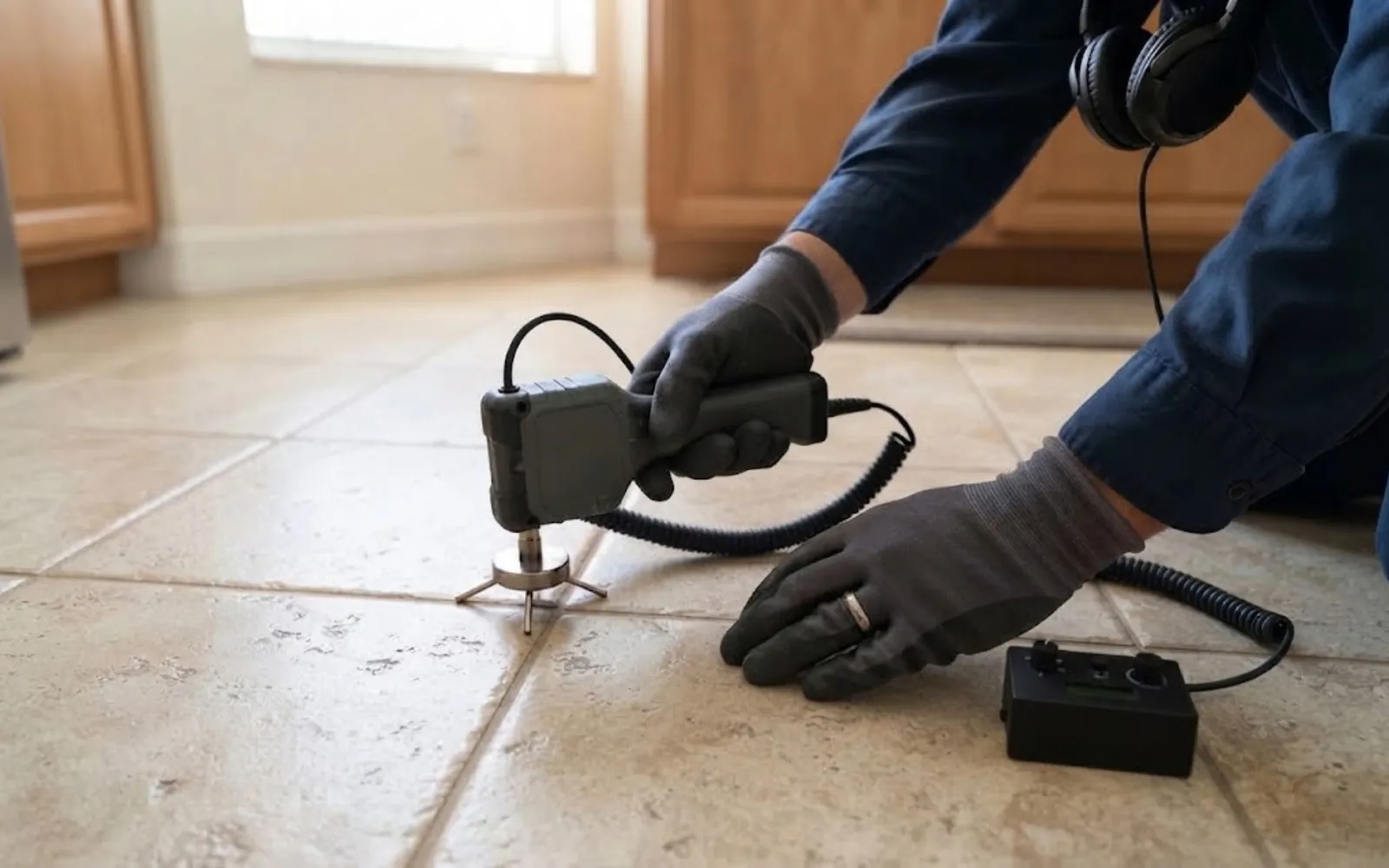
| Acoustic listening. | Ground microphones pick up the hiss of water escaping a pressurized pipe. | Pipes under concrete slabs and buried yard lines. |
| Thermal imaging. | A camera shows the temperature difference where hot water spreads under a floor or behind drywall. | Hot-water leaks under slabs and inside walls. |
| Tracer gas. | A safe gas mix is pushed into the line and detected where it seeps through the soil or slab. | Very small leaks that make little noise. |
| Moisture mapping. | Meters read water content in drywall, baseboards and subfloor. | Ceiling stains, wall leaks and bathroom seepage. |
Most jobs use two or three of these in sequence. The pressure test tells us which line, and the listening or thermal work tells us where on that line.
Where leaks tend to hide in Gainesville houses
Location follows construction. Slab homes built from the 1960s through the 1980s often run copper supply lines through the concrete. Those lines sit on sand and limestone that shifts, and the pipe wall thins over decades. When a leak turns out to be under the floor, our targeted slab leak repair team takes it from there.
Newer houses in the west and southwest often route supply lines through the attic instead. A leak up there shows up as a ceiling stain in a hallway or closet, usually after a hot stretch of summer.
Yard lines are the third common spot. A crack between the meter and the house never shows up indoors at all. It just keeps the meter moving, and that is a job for water service line repair rather than anything inside.
Other signs worth a leak test
- A warm spot on tile or concrete. Hot water escaping under a slab heats the floor above it.
- The water heater runs when nobody is using hot water. It is refilling a tank that is draining somewhere.
- Musty smell under carpet or behind a vanity. Humidity in Gainesville hides small leaks until mold gives them away.
- Low pressure at one end of the house only. Water is escaping upstream of those fixtures.
- Soggy grass in a dry week. A buried line or an irrigation zone is leaking.
- A toilet that refills on its own. Often a worn flapper. A quick simple toilet repair may end the mystery before a full leak test is needed.
What a leak detection visit looks like
- Meter and fixture check. We confirm the leak is real and measure how fast the meter moves.
- Isolation. Hot, cold, yard and irrigation lines are tested one at a time.
- Locating. Listening, thermal or tracer gas work narrows the leak to a spot we can mark on the floor or ground.
- Findings and options. You get the location, the likely cause and the repair choices with prices, before any repair starts.
If the house has several old leaks rather than one, patching can stop making sense. In that case we will say so and explain what repiping the supply lines would involve instead.
Paperwork for a GRU leak adjustment
If you plan to ask GRU for a courtesy adjustment, start collecting proof the day you notice the problem. It is much harder to rebuild afterward.
- Photograph the meter. Take a photo of the reading and the moving low-flow dial, with the date, before anything is repaired.
- Keep the detection findings. The written location and cause of the leak are the verification part of the request.
- Keep the repair invoice. It should name the address, the date and what was fixed.
- Wait for a normal bill. GRU applies adjustments after usage returns to normal, so the next reading matters too.
We write the findings in plain language with the location marked, so they can go straight into the request.
Leak detection for rentals and commercial buildings
Leaks in multi-unit buildings are harder to pin to one unit. A leak can start in an upstairs bathroom and show up two rooms away on the floor below. Isolation testing one unit at a time is slower, but it is the only way to bill the right repair to the right place.
Commercial properties add backflow assemblies, larger meters and long service lines, often with several buildings on one meter. Restaurants and offices near downtown and along Archer Road are typical. We schedule testing around business hours where we can, and after hours when the water can only be shut off at night.
What leak detection costs depends on these factors
- Where the leak is. An attic line is faster to find than one under a slab or 60 feet of buried yard pipe.
- How many lines need testing. A house with irrigation, a pool and a detached garage has more to isolate. Pools get their own process under pool leak detection.
- Time of day. Any after-hours rate is quoted on the phone before dispatch.
- Repair versus finding. Detection is priced separately from the repair, so you can compare before you commit.
On insurance: Florida homeowners policies generally treat the pipe repair as maintenance, but many cover the cost of reaching a sudden leak and the damage it caused. Your policy wording decides it.
Want your real number? Call (954) 697-4920. Non-emergency estimates are free.
Leak detection across Gainesville and nearby towns
We run leak detection in every Gainesville ZIP, from older slab homes in 32605 and 32606 to newer construction in 32608 and 32653. Irrigation leaks are common in the newer subdivisions, where sprinkler lines run under most of the yard.
The same goes for newer builds out in Newberry, where larger lots mean longer service lines and more irrigation zones to test.
Sources: GRU leak adjustment guidelines and GRU leak detection guidance. Wastewater billing on water usage per GRU customer service.
Leak detection questions from Gainesville homeowners
No. The point of leak detection is to find the exact spot first. If a repair does require opening a floor or wall, it is a small, targeted opening at the marked location, and you approve it before it happens.
Yes. The line is answered 24/7. If water is visible, shut off the main valve first, then call. Pinpointing a slow hidden leak can usually wait for daylight, and we will tell you honestly if it can.
GRU is responsible for the meter and the utility side of it. Leaks on your side of the meter, in the yard line or the house, are the owner's to find and repair. GRU does offer courtesy bill adjustments for verified, repaired leaks.
Most homes take one to three hours. A property with irrigation, a pool or a long yard line can take longer, because each system has to be isolated and tested separately.
Summer irrigation raises bills across Gainesville, so a seasonal bump is normal. A leak shows up as a meter that moves with everything off. Run the ten-minute meter test above. If the dial is still, the higher bill is usage, not a leak.
Yes. Property managers can book the test directly. Tenants need to keep water off during the isolation stage, which is usually under an hour, and the findings go to the owner or manager.