Low Water Pressure in a Gainesville Home: Causes and Fixes
The short answer
If only one faucet or shower is weak, the cause is almost always a clogged aerator, showerhead or cartridge, which hard water makes common here. If the whole house is weak, look at the main shutoff, a failing pressure regulator, old galvanized pipe, a leak, or, on a well, the pressure switch and tank.
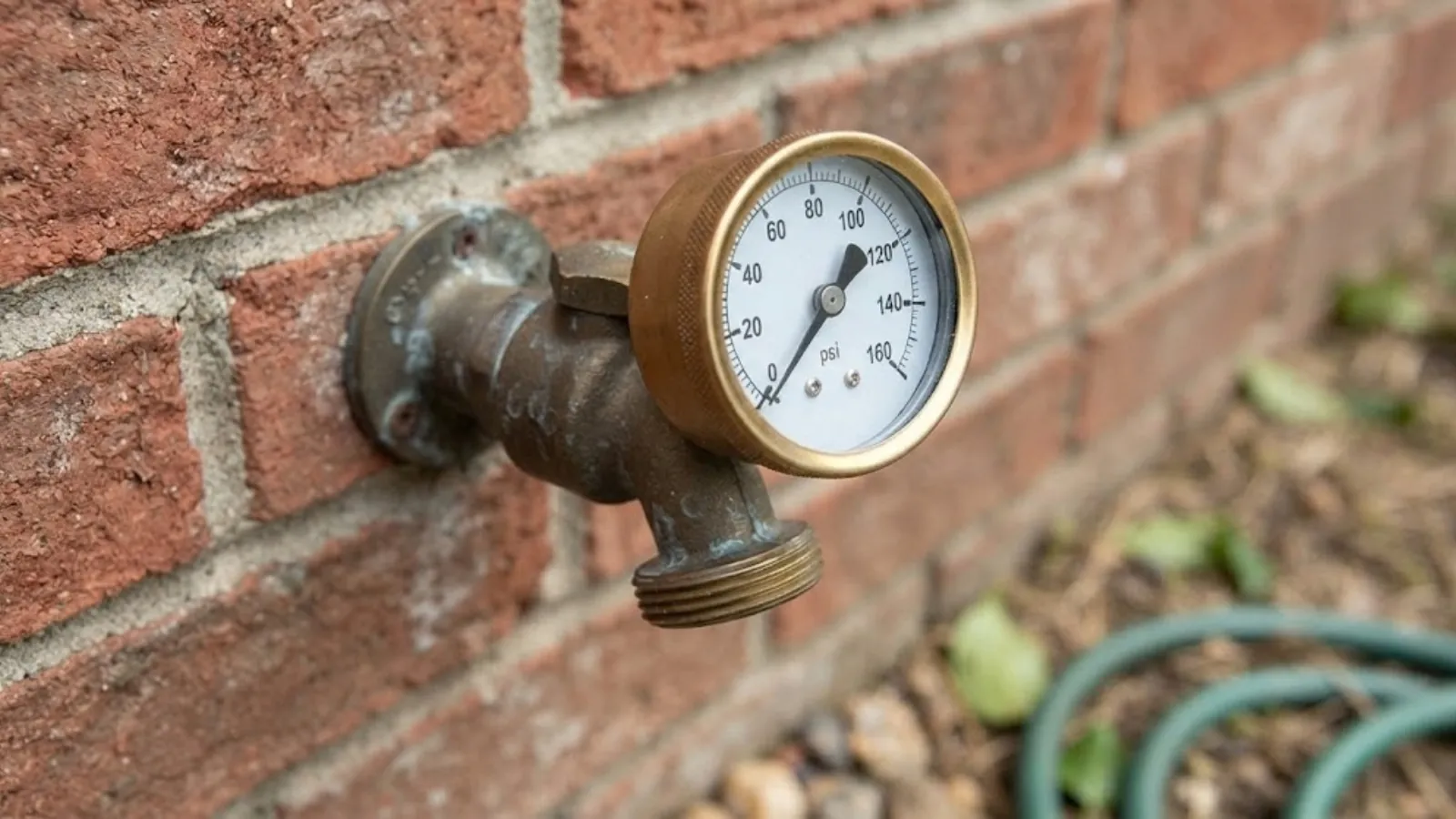
A simple pressure gauge on an outdoor spigot tells you a lot in two minutes.
Start by narrowing it down
| Pattern | Likely cause | First step |
|---|---|---|
| One faucet or showerhead. | Scale in the aerator, showerhead or cartridge. | Clean or replace that part. |
| Hot water only, whole house. | Water heater shutoff partly closed, or sediment. | Check the valve, flush the tank. |
| Whole house, started suddenly. | Main valve partly closed, utility work, or a leak. | Check the valve and your neighbors. |
| Whole house, worse over years. | Galvanized pipe closing up, or a failing regulator. | Pressure test and pipe check. |
| Whole house, on a well. | Pressure switch setting, tank or pump. | Watch the pressure gauge at the tank. |
Hard water and single-fixture problems
GRU's water carries about 8.2 grains per gallon of hardness. Every faucet aerator and showerhead catches a little of that mineral over time, until the flow narrows noticeably.
The fix is usually easy. Unscrew the aerator or showerhead, soak it in white vinegar for an hour, rinse and reinstall. If flow is still weak, the cartridge inside the faucet or shower valve is the next suspect, and it usually needs replacing rather than cleaning.
The two-minute pressure test
A hose-thread pressure gauge costs little at a hardware store and screws onto an outdoor spigot.
- Turn off all water inside. So you're measuring static pressure.
- Screw the gauge onto the spigot closest to where the main enters. Open the spigot fully.
- Read it. Household pressure commonly runs somewhere around 40 to 80 psi. Plumbing code calls for a pressure regulator when street pressure exceeds 80 psi.
- Open a tub faucet inside and watch the gauge. A big drop under flow points to a restriction in the pipes or a partly closed valve.
Low static pressure points to the supply side: the utility, the service line or a regulator. Good static pressure with a big drop under flow points to pipes inside the house.
Galvanized pipe: the slow pressure thief
In Gainesville's older neighborhoods, a common cause of pressure that gets worse over years is galvanized steel supply pipe. It rusts from the inside, and the rust and scale narrow the pipe until very little water gets through.
Signs include brown water after the house sits, pressure that's worst at the far end of the house, and a pipe that looks dull gray with threaded joints where it enters the house. There's no cleaning galvanized back to full flow. Replacement is the fix.
When the cause is outside the house
If pressure dropped suddenly and your neighbors noticed it too, the cause is likely on the utility side, like a main break or repair work. GRU, or your town's utility if you're outside Gainesville, is the one to call.
If it's only your house, the buried service line between the meter and the house can be the problem. A leak in that line steals pressure and runs up the bill, and an old galvanized service line can close up just like indoor pipe.
Pressure regulators, where installed, also wear out. A failing regulator can cause low pressure, or the opposite, pressure that creeps too high and stresses fixtures and water heaters.
Too much pressure is a problem too
Pressure that's too high doesn't feel like a problem, since showers are strong, but it wears out plumbing. High pressure makes faucets drip, toilet fill valves fail early, relief valves on water heaters discharge, and supply hoses on washers and dishwashers burst.
If your gauge reads above 80 psi, the plumbing code calls for a pressure-reducing valve. If you already have one and pressure has crept up, the regulator is likely failing. Either way, it's worth fixing before it takes a washing machine hose with it.
Before you call anyone
- Check that the main shutoff is fully open. A valve left partly closed after a repair is a common, free fix.
- Clean aerators and showerheads. Especially on the fixtures you notice most.
- Check the water heater's cold inlet valve. If only hot water is weak.
- Ask a neighbor. It tells you whether the problem is on the utility side.
- On a well, look at the tank gauge. Readings that swing quickly point to the pressure tank.
Fixing pressure problems for good
If the pipes themselves are the problem, repiping restores full pressure in houses with galvanized supply lines. A weak or leaking line from the meter is handled by water line repair work, and leak detection confirms whether a hidden leak is stealing pressure.
Homes on private wells should start with private well pump repair, which covers the switch, tank and pump. After a city main repair, like the precautionary boil notice issued for two subdivisions in Hawthorne, running cold taps for a few minutes usually clears air and sediment.
Prefer to talk it through? Call (954) 697-4920, answered 24/7.
Water pressure questions
Commonly somewhere around 40 to 80 psi. Above 80, plumbing code calls for a pressure regulator.
Often a partly closed valve at the water heater, or sediment in the tank or its connections.
Yes. A leak in the service line or under the slab steals pressure. A meter that moves with everything off confirms it.
It prevents new scale from forming, which protects pressure over time, but it won't clear pipes already closed up.
A valve may not have been fully reopened. Check the main and any fixture shutoffs first.
Some loss with height is normal. A big drop usually means undersized or partly clogged pipe feeding the second floor.
It can during peak demand, especially early mornings and summer evenings when irrigation runs.
A correctly sized softener causes little pressure loss. An undersized unit, or one with a clogged resin bed, can restrict flow noticeably.
Replacing the supply lines usually takes a few working days for a typical house, and pressure returns as soon as the new system is connected.
Only if the cause is on the utility side of the meter. Pipes and valves on your side are the owner's responsibility.
According to: GRU water quality FAQ (hardness), City of Hawthorne boil water notices, and pressure regulator requirements in the Florida Building Code, Plumbing, based on the International Plumbing Code (IPC).