Backflow Testing and Prevention in Gainesville, FL
Backflow testing checks that a backflow preventer, the valve assembly that stops water from flowing backward into the public supply, still works. Prevention covers installing, repairing and replacing those assemblies on irrigation systems, homes and commercial buildings.
In Gainesville, GRU requires testing on a schedule and a certified tester has to file the results. A cracked assembly spraying water after a freeze is a different matter, and the line is answered 24/7 for that.
Got a testing notice from GRU?
That letter is how most Gainesville owners find out they have a backflow assembly at all. Here's what it's asking for.
- A test by a certified tester. Owners can't test their own assembly. The tester needs current certification.
- Proof filed with GRU. The certified tester submits the test results to GRU within 30 days of testing.
- Repairs if it fails. A failed assembly has to be repaired or replaced, then retested.
- Doing it on time. Missing the deadline can put the water service at risk, so don't sit on the notice.
What a backflow preventer does
Normally, water flows one way, from the GRU main into your property. Backflow is when it reverses. That can happen when pressure in the main drops, during a water main break or heavy hydrant use, or when pressure on the property side climbs higher than the supply.
If that reversed water has touched fertilizer in an irrigation line, a boiler loop or a chemical process, it can contaminate the drinking water supply. A backflow preventer is a set of check valves and relief valves that stops the reversal.
GRU's cross-connection control rules require lawn irrigation connected to city water to be protected by a pressure vacuum breaker or a reduced pressure assembly. Where chemicals are injected into the irrigation system, a reduced pressure assembly is required.
Common backflow assemblies
| Assembly | Where you'll find it | Protects against |
|---|---|---|
| Pressure vacuum breaker (PVB). | Residential irrigation systems. | Back-siphonage from sprinkler lines. |
| Reduced pressure zone (RPZ). | Irrigation with fertilizer injection, commercial and high-hazard sites. | High-hazard backflow, both back-pressure and back-siphonage. |
| Double check valve assembly (DCVA). | Fire sprinkler lines and some commercial services. | Lower-hazard backflow. |
| Hose bibb vacuum breaker. | Outdoor faucets. | Back-siphonage through a garden hose. |
How a backflow test works
- Shut down briefly. Water to the assembly is shut off for the test, usually less than half an hour.
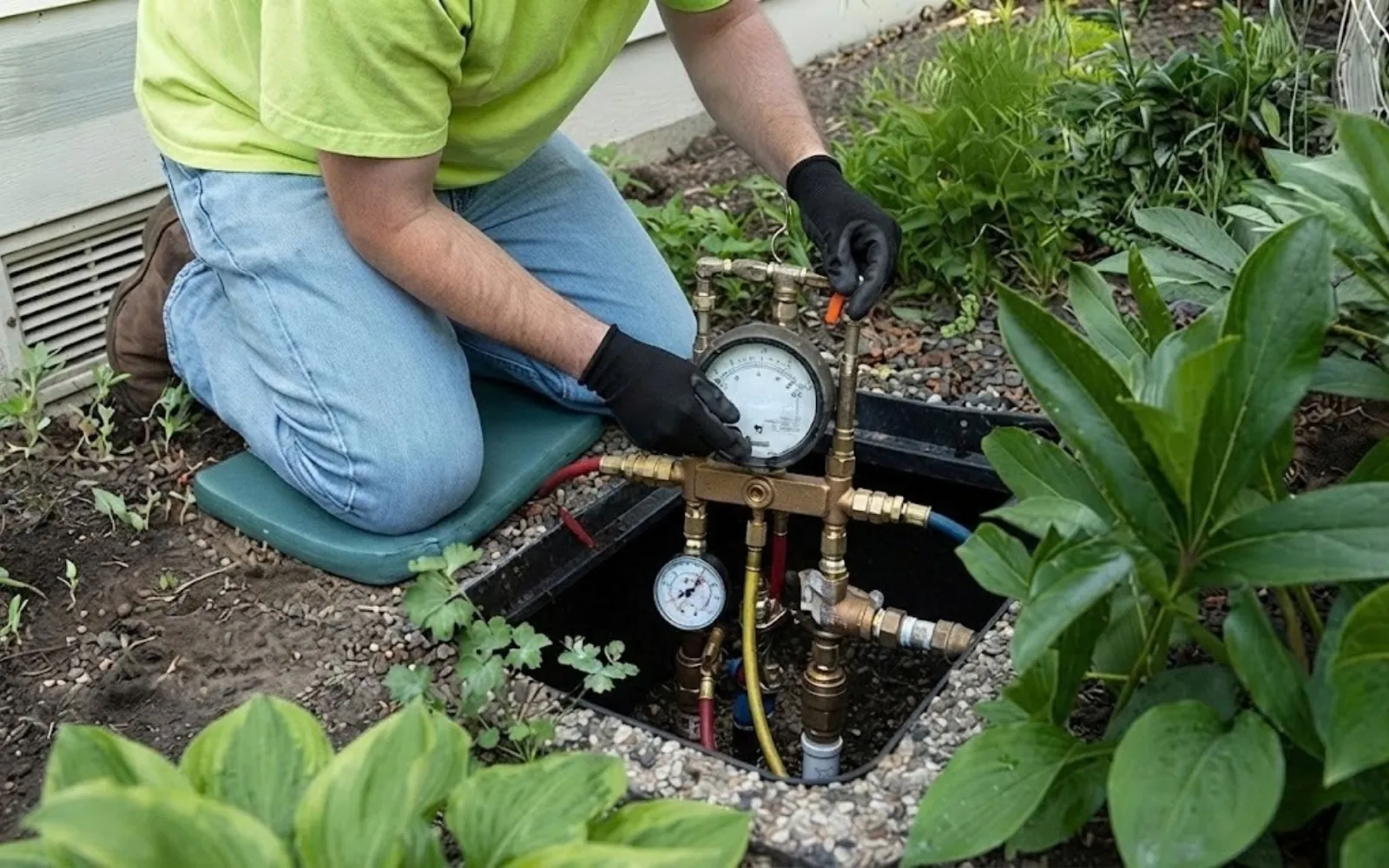
- Connect the test kit. A differential pressure gauge is attached to the assembly's test cocks.
- Check each valve. Every check valve and relief valve is tested against its required pressure.
- Record and file. Results go on the test report, and the certified tester files it with GRU.
- Repair if needed. Worn rubber parts are replaced from a repair kit, and the assembly is retested.
Freezes and backflow assemblies
Residential backflow preventers usually sit above ground near the irrigation line, fully exposed. On the rare nights Gainesville drops well below freezing, they're often the first thing on the property to crack.
An insulated cover or a wrap before a hard freeze prevents most of the damage. If yours has already split and is spraying, shut off the irrigation supply valve and call. The repair is covered on our emergency burst pipe repair calls too.
What affects backflow pricing
- Assembly size and type. A residential PVB tests faster than a large commercial RPZ.
- Pass or fail. A passing test is one visit. A failure adds parts and a retest.
- Replacement. A freeze-cracked body usually means a new assembly.
- Number of assemblies. Commercial sites often have several, each tested separately.
Want your real number? Call (954) 697-4920. We'll quote the test before the visit.
Commercial properties and irrigation-heavy sites
GRU requires non-residential backflow assemblies to be maintained and tested every year, and it can require testing more often in some cases. Restaurants, medical offices and multi-unit buildings can carry several assemblies on one property. Our light commercial plumbing service keeps them on schedule.
Larger irrigation systems in newer subdivisions, around Alachua and west Gainesville, rely on these assemblies too. If an assembly keeps failing because of high pressure or debris, the cause may be upstream in the service line.
GRU Manual of Cross Connection Control (testing schedules and irrigation requirements), GRU backflow prevention guidance (30-day filing window), Florida Administrative Code 62-555.360, and the AWWA Manual of Practice M14 standard GRU references for cross-connection control.
Backflow testing questions
GRU requires annual testing for non-residential assemblies and sets the schedule for residential ones. Your testing notice from GRU tells you when yours is due.
No. Testing has to be done by a certified tester, who files the results with GRU.
Shut off the irrigation supply valve, or the main if there isn't one, and call. The line is answered 24/7.
Usually worn rubber seals or debris in a check valve. A repair kit and a retest often fix it.
If it's connected to GRU water, yes. GRU's rules require a pressure vacuum breaker or a reduced pressure assembly on lawn irrigation.
A hose bibb vacuum breaker. It screws onto the spigot and stops a garden hose from siphoning water back into the house lines.