Tankless vs. Tank Water Heaters in Gainesville
The short answer
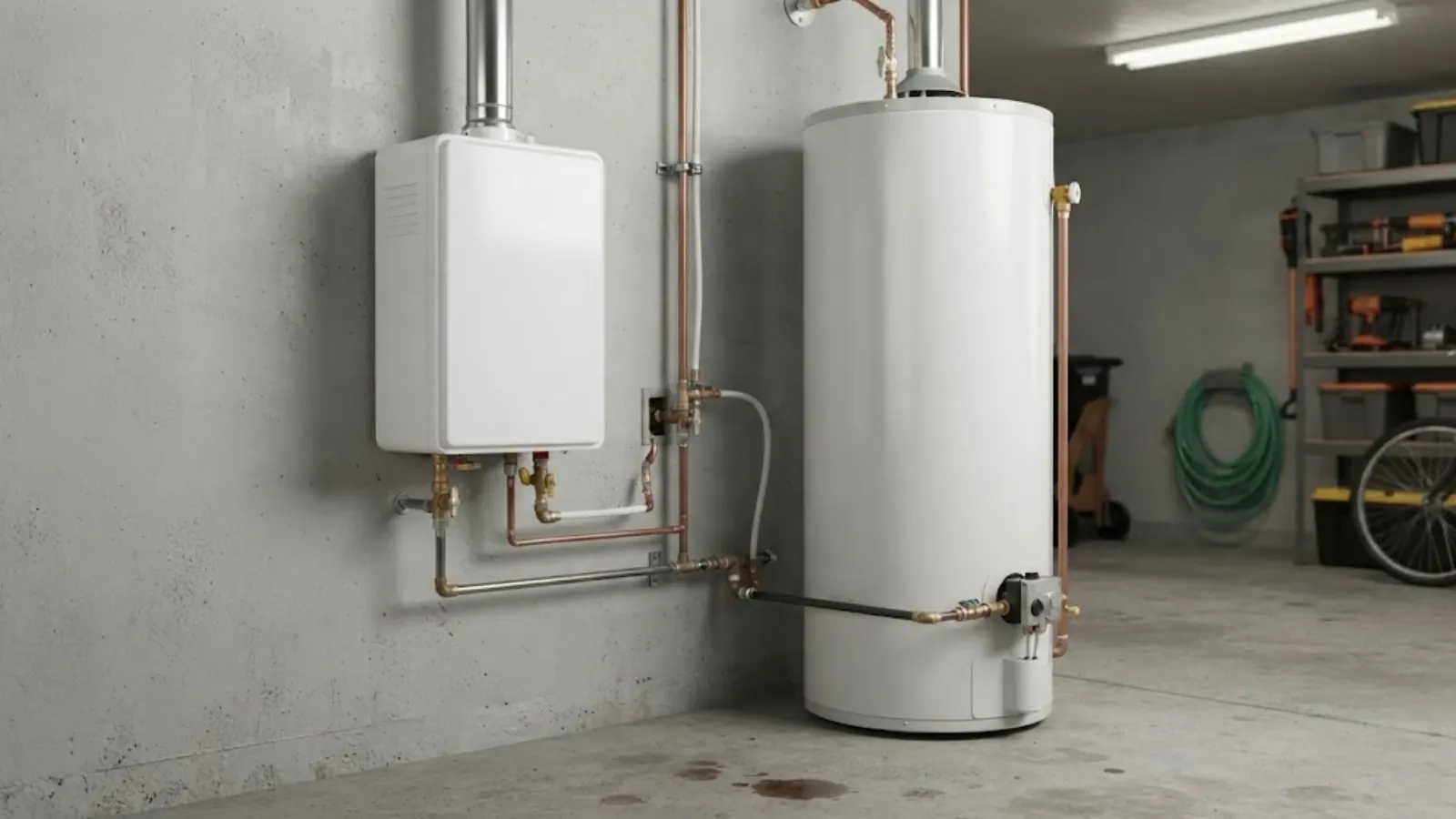
A tank water heater is the simpler, lower-cost choice and fits most Gainesville homes well. A gas tankless unit makes the most sense for bigger households that run out of hot water, owners planning to stay many years, and homes that already have natural gas with room for a larger gas line.
On GRU's water, at about 8.2 grains per gallon of hardness, a tankless unit needs yearly descaling to deliver its long life. If that maintenance won't happen, a tank is usually the better buy.
Side by side
| Factor | Tank | Tankless (gas) |
|---|---|---|
| Upfront cost. | Lower. | Higher, more if gas line or venting changes. |
| Hot water supply. | Limited by tank size. | Continuous, limited by flow rate. |
| Typical life. | About 8 to 12 years. | Often 15 years or more with descaling. |
| Maintenance on GRU water. | Yearly flush, anode checks. | Yearly descale, inlet filter cleaning. |
| Space. | Needs floor space. | Wall-mounted, compact. |
| Gas requirements. | Standard line usually fine. | Often a larger line. |
Hard water changes the math
Tankless heaters heat water in seconds as it passes through a narrow heat exchanger. That's where hard water drops its minerals. On Gainesville water, scale builds up steadily inside the exchanger.
Scale leads to the problems tankless owners complain about: error codes, bursts of cold water, and units that can't keep up with two showers at once. A yearly descale prevents most of it. Skip it for several years, and the exchanger, the most expensive part, can fail.
Tank heaters suffer from hard water too, as sediment on the bottom and a used-up anode rod, but they're more forgiving of missed maintenance. A water softener helps both types.
Natural gas in Gainesville
GRU provides natural gas to much of Gainesville. If your home already has it, a gas tank or gas tankless heater is straightforward. If it doesn't, the first question is whether gas is available at your street.
GRU offers rebates to convert electric, oil or propane water heaters to natural gas, with conditions. The program doesn't cover replacing one gas heater with another, and installation has to be done by a GRU Natural Gas Partnering Contractor. Check the current terms with GRU before you decide.
Tankless gas units also draw a lot of gas at once. Many need a larger supply line than the old tank used, which adds cost and is easy to overlook in a quote.
Don't forget heat pump water heaters
For homes without gas, a heat pump water heater is a strong third option. It's a tank unit that pulls heat from the surrounding air, and a warm Florida garage gives it plenty to work with, so it uses much less electricity than a standard electric tank.
It needs space and airflow around it, a condensate drain, and a higher upfront budget. In exchange, it lowers running costs without any gas work.
Sizing a tankless unit in Florida
Tankless units are sized by flow rate, in gallons per minute, and by how much they need to raise the water's temperature. Florida has an advantage here. Groundwater arriving at the house is warmer than in northern states, so a unit doesn't have to work as hard to reach shower temperature.
That still doesn't make every unit enough. Add up what you might run at the same time, such as two showers and a dishwasher, and size for that. An undersized tankless heater is the one that runs cold when a second shower starts.
Questions that decide it for most households
- Do you run out of hot water now? If yes, a larger tank or a tankless unit. If no, a like-for-like tank is usually fine.
- Do you have natural gas at the house? Without it, tankless gas is a bigger project. Consider heat pump or electric tank.
- How long will you stay? Tankless savings come over years. A short stay favors a tank.
- Will someone descale it every year? On GRU water, this decides whether tankless lives up to its promise.
- Where will it go? Attic and closet installs raise the stakes of a tank leak, which can favor tankless or a well-protected tank.
What installation involves for each
A like-for-like tank swap is usually a few hours: drain and remove the old tank, set the new one, connect it, add an expansion tank or drain pan if code requires it, and test. Replacements are permitted work in Gainesville and Alachua County.
A tank-to-tankless conversion takes longer. It can involve a larger gas line, new venting through a wall or roof, an electrical outlet for the unit's controls, and service valves so it can be descaled later. Ask for all of those to be itemized in the quote.
Choosing and installing
Code-compliant water heater installation covers tank, heat pump and tankless options with sizing. If you already own a tankless unit, tankless water heater service keeps it descaled, and gas line work sizes the supply for a new one.
Newer homes out in Newberry face the same choice when a builder-grade tank reaches the end of its life.
Prefer to talk it through? Call (954) 697-4920, answered 24/7.
Tankless vs. tank questions
It can over time, especially for larger households, but it costs more up front and needs yearly descaling on GRU's hard water.
A properly sized gas unit usually can. An undersized unit, or one with scale buildup, may not.
Whole-house electric tankless units need very large electrical service, which many homes don't have. Heat pump tanks are often the better electric option.
About once a year for most households, more often with heavy use, less with a softener.
GRU's natural gas water heater rebates apply to converting from electric, oil or propane to natural gas, with conditions. Check with GRU for the current terms.
Often most of a day, longer if the gas line or venting needs significant work.
Many gas models are made for exterior mounting, which frees up indoor space and simplifies venting.
Most gas tankless units need electricity for their controls and fan, so they stop working without power. A gas tank heater with a standing pilot may keep making hot water.
It can be, especially on a budget. A 50-gallon or high-recovery tank covers many busy households at lower upfront cost.
According to: GRU water quality FAQ (hardness), GRU natural gas water heater rebate program terms, and installation requirements under the Florida Building Code, Plumbing and Fuel Gas volumes.